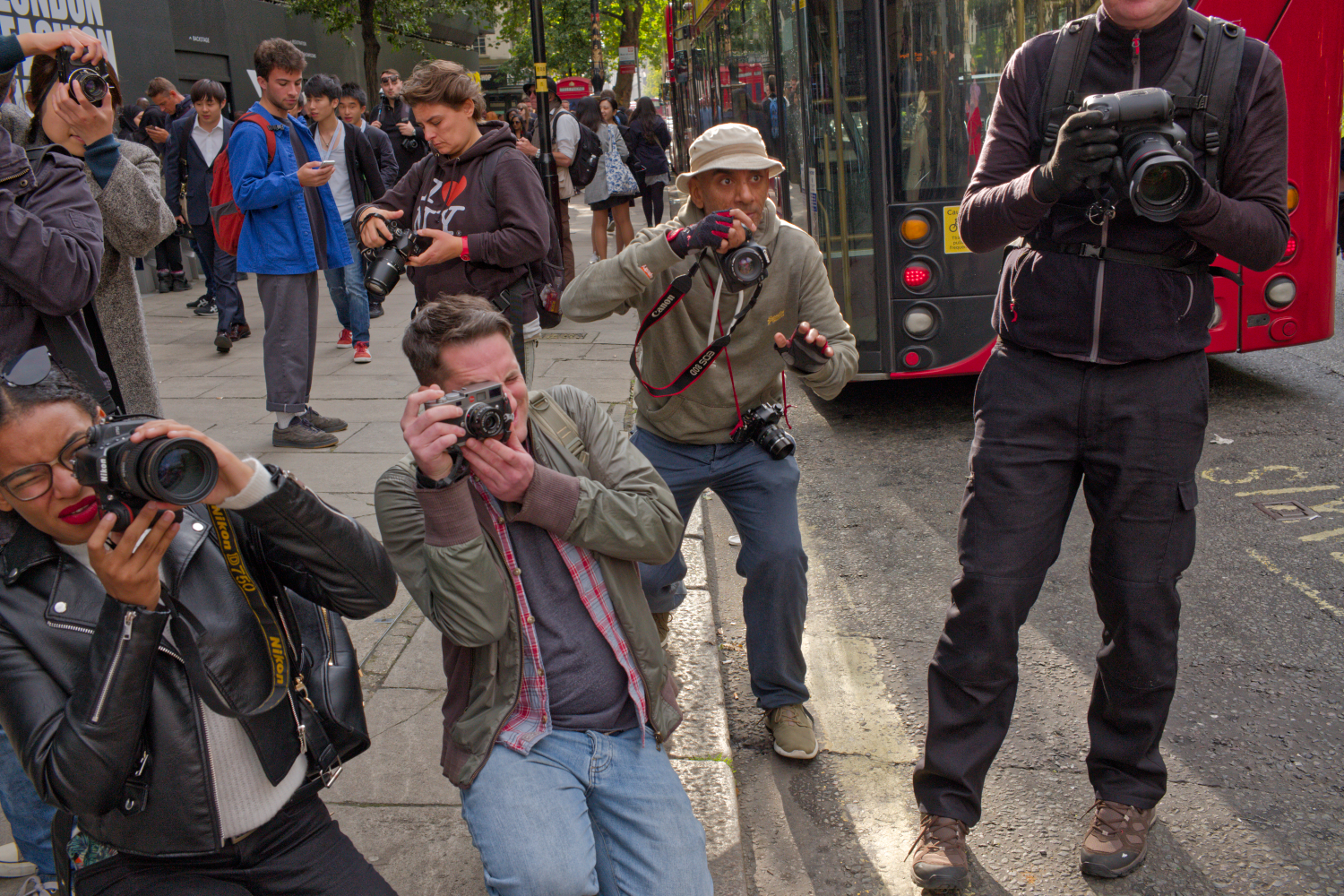
As a Street Photographer, when I am out on the street with a camera in my hand, it is black, small and obvious the moment you see it. I make photographs of life as it is lived in the City. You know the process. You have stood in your own version of that street, in your own city, doing the same thing in the open where anyone can see you. Lately, I notice people react in a way they did not before, and it is worth asking why, because the answer is not us.
The pictures we care about were made in the open and of the world. Winogrand on the street, Frank in America, Levitt in New York, Evans on the subway, Parr at the seaside and at events. None of them hid. The camera was up and visible, the photographer was there, and the people in the frame could see it happening. That is the tradition we work in, and it rests on something fragile, a social licence to photograph in public that has held for the best part of a century. That licence is under pressure now, and not because of anything a street photographer does.
The pressure comes from two things arriving at once, covert recording built into ordinary looking glasses, and AI surveillance spreading through public space. Both are about watching people who do not know they are being watched. Here is the risk for us. The public feels the creep of being recorded, they are right to feel it, and in that mood a person with a visible camera gets lumped in with a person wearing a camera on their face. We become the nearest target for a fear that belongs somewhere else. So we had better be able to say, plainly, why the visible photographer is the opposite of the thing people are afraid of.
Visibility is accountability. A camera raised to the eye cannot be switched off or hidden, it is the whole gesture, and it is over in a fraction of a second in front of a person who can see it happen. Standing on the street with a camera everyone can see, I carry the consequence of what I am doing, in that moment, on that street. I can be questioned, I can be told or asked to stop, I can be told to delete a frame, and I can be sworn at, and none of that is unreasonable. The person wearing smart glasses carries none of this.
The Guardian ran a piece this month by Tayo Bero about Meta’s AI smart glasses, and the celebrities being paid to make them look normal, Kylie Jenner among them. Bero’s worry is the covert part, and for women it is not abstract. Men have recorded women in bars and on the street and posted it to TikTok, Instagram and YouTube without their knowledge. Bero gave an example of one woman who was recorded and then asked for money to take the video down. Meta’s answer is a small LED light that is meant to come on when the glasses record. CNN spoke to women who never saw a light, and there are people online teaching others how to get round it. So the safeguard is a light that can be switched off, on a device built to sit on a face and look like a pair of glasses . Very geeky glasses, I have to say. That exchange, the one the glasses remove, is part of our ethics as street photographers.
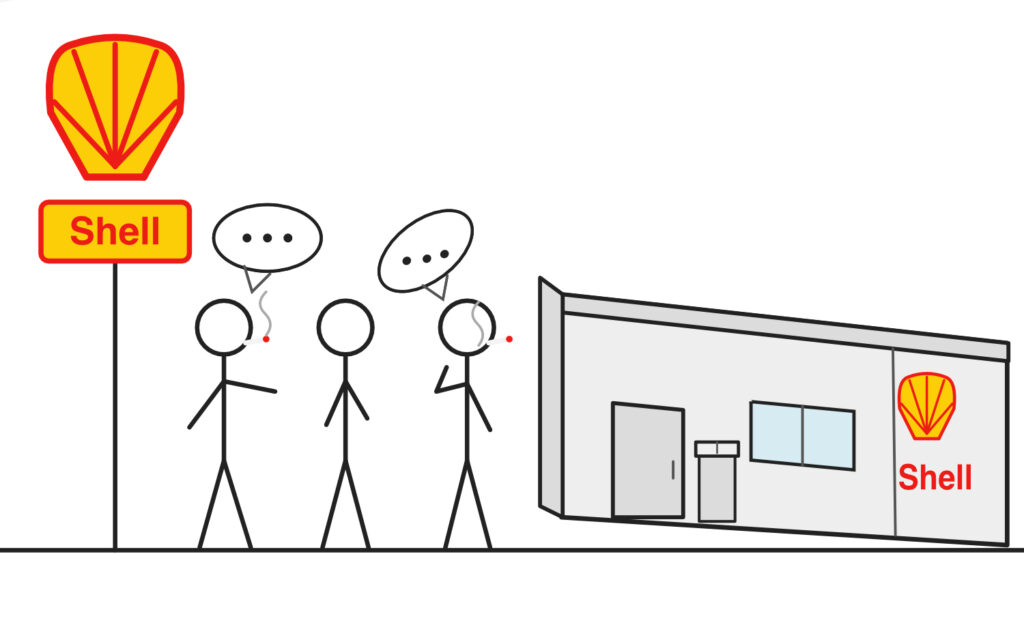
For example; behind a petrol station once, while I was making What is British?, my MA final project, which involved photographing a limited area within a mile of the Rotherhithe tunnel. I watched three young men who looked to me like they were up to something, though I could not for the life of me work out what. I watched them a while, then made a few frames. When they spotted me making a few images, they came over to me, not happy at all that I had made an image that included them, so I showed them the image on the back of the camera, and it was an innocent enough photograph, three lads standing about. It turned out they had all been in court that morning and were somewhere they were not meant to be. We had a chat. I deleted the image, and that seemed to make them happy. We left on good terms. That conversation would not have happened with a pair of glasses, and they would have been not he wiser that I had made images, but this then brings the ethics of making images this way in public into the frame. This is something that street photographers are going to have to navigate in the future.
And it does not stop at one man in a bar with a camera on his face. Wired found that Meta had quietly built face recognition into its app, a feature called NameTag that can pick a stranger out of what the glasses see, crop the face, and turn it into biometric data. Once a face becomes data it can be matched and kept, and that is where Bruce Schneier and Jon Penney pick up the thread. They wrote in the Guardian on 6 July about where this goes once it joins the wider surveillance industry. Facial recognition, mass databases, real time identification, records kept and tied to your government file. China has over 600 million surveillance cameras. They describe a man, Lao Duan, blacklisted after he lost his job and could not repay his loans, whose face was picked out at a Beijing intersection and put on a billboard with his name, his citizen ID, and a message that he was untrustworthy. In the United States the Department of Homeland Security is expanding facial recognition and social media monitoring to keep tabs on immigrants, journalists, and protesters. Larry Ellison, who runs Oracle, said that citizens will be on their best behaviour because we are constantly recording and reporting.
This is the part that should trouble us as photographers, and not only as citizens. Schneier and Penney call the result a chilling effect. People self-censor, they fall into line, they stop trying things. A street empty of people being themselves is a street with nothing on it worth photographing. The genre needs public life lived out loud, and that is exactly what mass surveillance quiets. Same-sex relationships went from illegal to legal because a counterculture could experiment in public first, and show the rest of the country that morality moves. Watch everyone all the time and that stops, and the street that we want to photograph goes quiet.
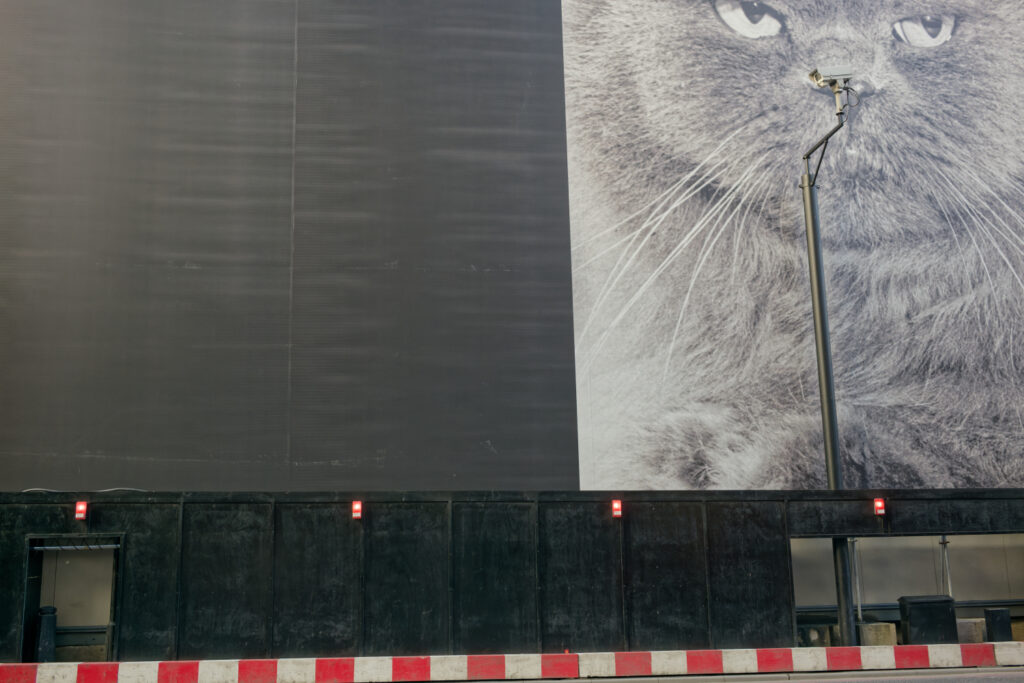
What separates our cameras from the glasses, and from the CCTV going up on poles across our towns and cities, is what each one is for, and where the picture ends up. We make photographs to show life as it is lived, one frame at a time, for a book, a print, an exhibition. The surveillance systems exist to identify you, keep the record, and enforce a rule against you the moment you break it, so that you behave because you know they are watching. Those are not the same thing. One is seeing to see the systems that we live our lives within, the other is the system looking so this information can be used for control or punishment.
Our materials make the case on their own. A film camera is mechanical, no screen, no burst, no wifi, no cloud, and a roll costs real money, six to fourteen pounds, so you are careful with it, you make a frame or two and you live with them. If you missed it you missed it. Even working digital, the files come home to be edited, most of them show nothing and are never seen again, and what survives your editing process is chosen because it says something to you as the photographer then hopefully the viewer, not because a machine flagged it. There is a negative, or a digital image, then a print, and your name against the work, not against the people in it.
So here is what I think we owe the craft now. Keep working in the open, keep the camera where it can be seen, keep having the conversation when someone asks, and be ready to explain the difference to a public who have good reasons to be nervous. We are one of the last honest ways of looking at each other in public. That is worth explaining and defending to those who challenge us when we make images in public.
Schneier and Penney, end on a choice, and they are right about it. None of this is fixed. We can ban facial recognition, we can restrict what data gets kept and for how long, we can regulate the most invasive uses, and we can decide that a camera which hides itself is not one we want on the street. I will keep standing where you can see me. I do not think the machine behind the glasses, or the cameras multiplying on the poles above our towns and cities, will ever offer you the same.
Bibliography
Bero, T. (2026) ‘Smart glasses are deeply creepy. Why are celebrities like Kylie Jenner endorsing them?’, The Guardian, 17 July. Available at: https://www.theguardian.com/commentisfree/2026/jul/17/ai-meta-smart-glasses (Accessed: 17 July 2026).
Schneier, B. and Penney, J. (2026) ‘AI surveillance is being supercharged – and it will chill social progress’, The Guardian, 6 July. Available at: https://www.theguardian.com/commentisfree/2026/jul/06/ai-surveillance-policy (Accessed: 17 July 2026).
Leave a Reply